
Dr Luisa Ostacchini
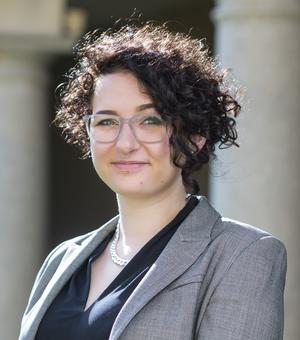
I joined Jesus College in 2024, and am honoured to be the inaugural Nelson J. Carr Career Development Fellow. This post is generously funded by Jesus College alumnus Mr Christopher Richey (1984, MPhil Management Studies) and the Richey Family Foundation. This role grants me vital time for my postdoctoral research in the field of global connections in Old English and Anglo-Latin Literature alongside developing and delivering academic skills support for Jesus students, especially those who join the College from disadvantaged backgrounds or with English as an additional language. To read more about the creation of this role, please click here.
My research broadly considers ideas of the world in medieval literature, and the role that the lives of saints played in constructing early medieval worldviews. In particular, I am interested in how writers and scholars from early medieval England (650-1100) were thinking about places outside of England, and how they saw their relationship to the global world around them. To this end, my interests largely move between the interrelated areas of translation between Latin and the vernacular; pre-modern national and international identity; medieval cosmography; the cult of saints; and medieval travel. I am also interested in questions of interconnectivity, inclusivity and intratextuality in medieval works, especially in collections of saints’ lives.
The Old English Martyrology
I am currently writing a monograph on the Mercian worldview of one of medieval England's longest and most impressive prose texts, the Old English Martyrology. In this work, I am interested in both the text's global and outward-looking interests, and the Mercian identity at its heart. I examine both the wide-ranging geographies of this chronically understudied text and the extensive network of Latin, Greek, Hebrew and Syriac sources which facilitated its production. This project, then, sheds new light on Medieval English engagement with the non-European world; grants fresh insight into Mercian cultural identity; and further illuminates translation practice, rationale and literary art behind one of the most important and most neglected works of European medieval encyclopedic writing. I have recently published work from this project on the martyrologist's use of a portent from ancient Egypt and on the depiction of Carthage in the OEM.
Ælfric of Eynsham
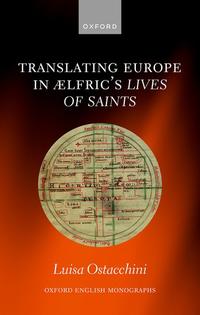
My first book, Translating Europe in Ælfric’s ‘Lives of Saints’ (2024, Oxford University Press) focused on the relationship between England and Europe in the tenth century. Interest in England’s relationship with its European neighbours is by no means a modern phenomenon, and across his prodigious corpus Ælfric of Eynsham (c. 950–1010), the most prolific and stylistically accomplished prose writer in all Old English literature, writes repeatedly about the relationship between England and Europe. My book examines the representation of European places, people and community (and England's relationship with and ability to be part of that community) in his Lives of Saints, an extensive collection of stories about saints, most of whom are European. In doing so, I consider the ways in which Europe constituted a vital part of Ælfric’s didactic praxis concerning unity and the global church at a time of national crisis. The book has been reviewed in Translation and Literature, Biography, and JEGP.
I have also published on Ælfric's representation of India and Rome, on his use of sources in the Lives of Saints, and on his homiletic practice when translating material from Latin into the vernacular.
I teach broadly across the Medieval period, with a particular interest in pre-conquest literature. In addition to teaching the various medieval papers, I lecture on Old English poetry and prose for undergraduate students, and teach Latin and Old English language classes and research methods for postgraduate students. I also teach both the history of the English language and contemporary literary theory, and have particular interests in queer theory and translation studies.
I am happy to supervise undergraduate and MSt dissertations on any aspect of pre-conquest literature, particularly on hagiography, translation, or theoretically informed approaches to medieval texts.
Undergraduate teaching:
Prelims Paper 1A (Introduction to English Language)
Prelims Paper 1B (Introduction to English Literature)
Prelims Paper 2 (Early Medieval Literature, c. 650-1350)
FHS Paper 2 (English Literature 1350-1550)
Course II FHS Paper 1 (Literature in English 600-1100)
Faculty Lecturing (recent series include 'Saints, Sinners and Superheroes in Early Medieval English Literature'; 'Ideas of the World in Old English Literature'; and 'Ælfric of Eynsham: Saints and Scandal in Old English Prose')
Postgraduate teaching:
Medieval Latin for Beginners (MSt / DPhil)
Research Methods (MSt in Medieval Studies)
Book
Translating Europe in Ælfric's ‘Lives of Saints’ (Oxford University Press, 2024).
Articles / Book Chapters
"Carthago describenda est: Depicting Carthage in the Old English Martyrology", Review of English Studies 76 (2025), 481–504
"A New Analogue For The Portent of the Talking Lamb in the Old English Martyrology", Notes and Queries 72.3 (2025) 200–204
"Ælfric of Eynsham and the Treatise De ebrietate cauenda of Boulogne-sur-Mer, Bibliothèque Municipale, MS 63" Journal of Medieval Latin 34 (2024), 1-25
"Rome Away from Rome: India, Rome and England in Ælfric’s Life of Saint Thomas", in Ideas of the World in Early Medieval English Literature, edited by Kazutomo Karasawa, Francis Leneghan, and Mark Atherton (Brepols, 2022), pp. 127–47
"BHL 2178: A New Source for Ælfric's Life of Dionysius", Notes and Queries 69.3 (2022), 187-189
"Fair or Fowl?: Golding's Translation of Ovidian Bird Lore into Moral Exempla", Reinvention, BCUR 2014 Special Issue (2014)
In 2025–26 I am the co-chair of the English Faculty's Early Career Forum. I am also co-chair and Divisional Representative of the Humanities Researcher Forum. In these roles, I am always keen to hear from Early Career members of the Faculty to discuss researcher support and development: please do get in touch!

